Monday, February 18, 2013

Co. Mayo: Conflict of the Shell Corrib Gas Project


Almost everyone I talked to in Dublin described Mayo as “wild country.” Being close to the coast and subject to any storm that crosses the Atlantic, the weather can be volatile. We were lucky and only experienced a bit a rain during our visit. The main purpose of going to Mayo was to study the conflict brought on by the pipeline project implemented by Shell Oil Company. Before I came to Ireland, I was completely oblivious to this issue, which is unbelievable to look back upon now that I’ve seen the land, met some people involved, and heard their stories.


During the past week, I have been on a rollercoaster ride of emotions listening to history, “facts”, personal testimonies, walking the land, talking with Shell representatives, touring the construction sites, and being physically present in an area that will be a place of unrest for many years to come.

The parish we stayed in is called Kilcommon, a predominantly rural and isolated area located on the Erris peninsula, which juts out into the Atlantic Ocean. The controversial Corrib gas field is located 80 kilometers off the coast. The pipeline has been laid offshore from the wells to Glengad. Shell plans to run the pipe from Glengad, beneath Sruwaddacon Bay, to the onshore refinery at Bellanaboy Bridge. The construction directly affects the Kilcommon parish community, but also impacts those who live outside the construction area.

Hostel we stayed in owned by Betty 


Beauty of the Bay
During our first full day in the area, Simon Sweeney, an environmentalist with a special interest in marine life, took us on a walking tour along the coast of Broadhaven Bay. Simon’s respect and knowledge for the land radiated through his descriptions about the many ways in which the locals interact with the land including the use of vegetation found in the bog and on the shore or special sheep grazing tactics. He also told us stories about the delicate balance that must be maintained in order to preserve the fragile area. Broadhaven and Sruwaddacon Bays have been declared Special Areas of Conservation (SAC) by the European Union in order to protect birds, fish, and reefs that can be found just off the coast.

Hike with Simon


Sphagnum moss found in bogs was used during WWI
in place of gauze


Sheep, sheep, and more sheep.

The communities that make up northern Mayo, like many other rural communities throughout the country, are rich in history and heritage. Some families have been in the same community for generations, while others are relatively new. Regardless of how long they have lived in the area, many people we spoke to expressed the feeling of having deep ties to the land. Farmer Willie Corduff was quoted as saying, “I was born and reared on this farm. It’s memories that are making us do what we are doing…They’re the memories you have and the memories you have to keep. To see someone coming in now and trying to destroy it, as Shell is doing, it kills you. Our footsteps are around the place since we were able to walk.” Willie was one of the Rossport 5, a group of men who went to prison for defying a court order which permitted Shell to work on their land. The motivation behind their protest goes much deeper than property rights: it cuts to the core and deals with the ideas of identity and heritage.

Green fence and yellow backhoes in the distance mark
site landfall site

Overlooking the bay where the pipeline runs

One of our lecturers, author Michael McCaughan notes, “This is a community which takes pride in mapping out local place names and restoring gravestones, maintaining a connection between past, present, and future.” In an area possessing so many layers of history, it is impossible to unravel the past from present day. We spoke with retired school teacher Micheál (pronounced: Mee-hawl) O’Seighin and he noted that the echos of the past are important for daily life. The presence of the past can be physical, with ancient ruins dotting the landscape or gravestones placed a few years ago. But the past is also present in the retelling of stories and in the mindset of the people and is often awakened in times of struggle. Michael is a soft-spoken former teacher who was one of the Rossport 5 and spent 94 days in jail. Remarkably, he didn’t own any land affected by the pipeline, but he told us he went to jail because for him it was the completely logical and rational thing to do. Michael is not a radical, tree-hugging, granola-eating hippie (I know at some point reading this you thought about it…). He is a man who has strong ties to his family, the land, and has a deep sense of place.  


To the people living near the Shell project, the structures of society (police, judical system, government representatives) which ideally were created to protect their rights could no longer be trusted. Betty Schultz, a resident of Kilcommon wrote, “My elected representative lies straight to my face...I experience hostile response from all authorities. I witness the judge in court not batting an eyelid when listening to blatant purjury by the police.” Micheál pointed out that with the threat of the Shell project and the failure of the legal system to protect their rights, arose the feeling: “The only thing we could depend on was what stood the test of time before.” 


At the dock area. The fishing industry was
hit hard by the pipeline project


Protesting sign on a building in the middle of a field
 
Some people we spoke with believed that out of this conflict arose a newfound sense of unity within the community. In the initial stages of the project, many came out in protest, spent time discussing the project with neighbors, and participated in community forums. One could argue that this conflict has pulled Mayo into a much more global community with a concern for social justice and environmental protection. The creation of the solidarity camp is a perfect example of this global community. The camp is currently composed of people from Ireland, England, France, and Germany and has housed people from an even more diverse list of countries in recent years. Each individual comes to the camp for different reasons, but their purpose is to unite with the local community and work with them to make their voices heard. Kate, a longtime member of the solidarity camp told us that people throughout Ireland and the world have contacted local residents in search of advice in creating protest campaigns. Mayo has become an example (whether it be good or bad) for the world to reflect on.


I am a firm believer in the idea that in order to truly understand a place, you must spend time there. But after many experiences both home and abroad, I have found that sometimes understanding cannot be reached until you have removed yourself from the environment. This has been the case with my trip to Mayo. Now that I have had the chance to reflect, I realize that I have taken so much away from our short time in Mayo in terms of environmentalism, social justice, and conflict studies: all of which I hope to apply in other areas throughout the program, especially as I prepare to depart for Northern Ireland,  as well as in other areas of my life. In a written piece by our friend Betty, she identifies Shell’s presence within the community as occupation, which I believe to be a fitting description when I think of historical parallels. My first thought went to the occupation of France during World War II and the introduction of the Vichy regime. It is hard to believe that I am attempting to compare WWII to a small rural town on the coast of Ireland, but the two conflicts do share uncannily similar themes of confusion, lack of authority, collaboration, resistance, feelings of defeat, and a strong sense of memory. Northern Mayo may be a small area with a small conflict, but to the people in the midst of it all, it is a continuous battle and it is anything but insignificant. I believe Patrick Kavanagh captures this sentiment best in the last line of his poem titled Epic:


I have lived in important places, times

When great events were decided, who owned

That half a rood of rock, a no-man's land

Surrounded by our pitchfork-armed claims.

I heard the Duffys shouting "Damn your soul!"

And old McCabe stripped to the waist, seen

Step the plot defying blue cast-steel -

"Here is the march along these iron stones."

That was the year of the Munich bother.
Which
Was more important? I inclined

To lose my faith in Ballyrush and Gortin

Till Homer's ghost came whispering to my mind.

He said: I made the Iliad from such
A local row.
Gods make their own importance. 


More information on the Shell project in Mayo:

Video produced by Shell provides the corporate perspective.


Documentary The Pipe uses real footage from protest and town meetings combined with interviews to depict the feelings of residents living near the pipeline project. If your interested, it's definitely worth a watch.


Thursday, February 7, 2013

Scavenger Hunt Champs

One of our first assignments was to complete a scavenger hunt for different parts of Dublin. Each group of two was given a different section of the city and a list of places to find. I was paired with Danny and our section was Dublin 1, North Side starting at the Parnell Monument on O'Connell Street. In addition to locating and photographing each place, we also had to find a bit of history or complete a task. Here are a few of the sights we saw:


The Spire

The Spire is located on O'Connell Street and acts as a great meeting point as the structure towers high over any building in the city. The official name of the Spire is "The Monument of Light." It was built to replace Nelson's Pillar, another monument that stood in the same spot until 1966 when it was destroyed in an IRA bombing. We found that Dubliners were apathetic about the Spire as no one showed real enthusiasm with the idea. It has acquired various nicknames including: Pin in the Bin, Stiletto in the Ghetto, Dublin's Biggest Heroin Needle, and many others too "colorful" to mention here...

Our next stop was to head down Earl Street to find a statue of a famous Dubliner:


James Joyce

James Joyce plaques, statues, and quotes are dotted throughout the city. There are also various buildings named after his famous works, displaying Dublin's pride toward the local author. There's also a guy who shows up on different streets impersonating this statue. He scared me half to death the other day when he caught me looking at him and gave me a thumbs up. 


Peacock and Abbey Theater

The Abbey and Peacock Theaters were next on our list. We found out that they are housed in the same building. The Abbey Theater is the National Theater of Ireland and was started by W.B. Yeats.

Our next stop was a memorial recognizing the names of those who were killed in the Dublin and Monaghan bombings of 1974. These bombings were conducted by the Ulster Volunteer Force (UVF), a loyalist paramilitary group. The 33 people who were killed and the 300 injured in these bombings marks the highest number of casualties experienced in one day during The Troubles.


Memorial listing the names of 1974 bombings

From the memorial, we moved toward the Docklands to admire the mix between modern architecture and historical buildings. The ship, the Jeanie Johnston docked just up river from the newly constructed Samuel Beckett Bridge illustrate a perfect juxtaposition of the blending of past and present. The ship was used to bring the starving Irish to America during the famine.

Samuel Beckett Bridge


Jeanie Johnston


Not too far from the ship is the famine memorial. These statues are taller than 6 feet, and their long drawn out figures give them an even taller appearance.


Famine Memorial


Our final task was to take a team picture, so Danny and I took one on the bridge.

It was a bit windy....

In the end, we presented our scavenger hunt findings to the group in an awesome Power Point presentation and were voted as the winners. But even more awesome was the fact that our Program Director decided to let everyone in the group participate in the prize: a traditional music pub crawl. I'll definitely post about that when it happens! And to wrap up this post, I'll leave with some awesome graffiti we found near the Docklands. Pretty darn creative if you ask me!


Photo credit: Danny

Sunday, February 3, 2013

20 Dominick Street


My classroom is located at 20 Dominick Street in the city center. SIT rents from Youth Work Ireland, an organization that works with young people through different projects that facilitate social, creative, and educational development. Youth Work Ireland owns a four-story building at the end of a long block of identical structures. The Dominick family constructed the street in the 1750’s and in the 18th century it was known to be a fashionable section of Dublin.

Google Earth picture of 20 Dominick Street.
First red door from the right.

The very first time I pushed opened the heavy Georgian door and climbed the stairs to the second floor I was in awe. The walls are cream colored from floor to ceiling, broken up by decorative molding along the edges of the room. But beyond the two-dimensional plane of the walls, there are pairs of large birds, wings raised ready for flight, framed by the curls and flourishes of raised plaster. The patterns continue from the hallway into our own classroom and throughout the building. Click on the pictures to enlarge and see more detail!

Front door

Second floor hallway ceiling

Panoramic view of the hallway ceiling


Birds are a signature of this particular artist. 


Our classroom

View of the street from our classroom


However the building has a much darker past, despite the incredibly restored beauty it now possesses. During the famine (1845-1852), the house was sub-divided, becoming a dwelling for 30 or 40 families. At some point (date TBD) the Dominick Street area housed many soldiers from the British army helping brew the perfect environment for prostitution. The house was used as an orphanage until 1960. Today in 2013 Dominick Street is home to many low-income families.

Cars and buses race by and people talk on their cell phones right next to iron gates and heavy wooden doors that are centuries old. I just love the way in which bits and pieces of history have intertwined harmoniously with modern day.

Thursday, January 31, 2013

Week 1: Getting the hang of things


Tomorrow marks the end of my first week of classes and what a week it’s been! I can safely say I’ve mastered the art of getting to and from class. You might find that a bit funny, but hold your laughter until I’ve told you about my trek to school.

My day begins around 7:45 AM when I wake up, get dressed, have the day’s first cup of tea with my breakfast and leave the house. I have a 15-minute walk through the streets of my development, across the busy main road where cars hurtle by, down to the LUAS station. The LUAS is one of the many forms of public transport here in Dublin. “Luas” in Irish means “fast” and I would agree that the LUAS lives up to its name considering the ride only last 20 minutes compared to 40 minutes on the bus. The LUAS is a tram and has two different lines in the city of Dublin. Once I get to the station, I don’t wait very long as a different tram runs every 5 minutes or so. The tram is pretty well filled during the morning commute.


The LUAS

The LUAS drops me off at St. Steven’s Green at the very bottom of Grafton Street. This means I have about a 15-minute walk to the classroom if all goes well. When you factor in large crowds of people who walk at all speeds, road crossings where people hardly wait for a walk signal, rain, and of course the wind, the walk could take longer. I often find myself getting distracted by the window displays or small details I failed to notice before.  I follow Grafton Street to the top and take O’Connell Bridge across the River Liffey past the GPO: General Post Office, the site of the Easter Rising in 1916. The bullet holes in the pillars of the building keep the memory of the past alive as this building is seen as a symbol of Irish nationalism. I duck around the corner of the GPO onto Henry Street where I cut through the Iliac, a mall, onto Dominick Street where our classroom is located.


The GPO

This morning commute is very different from the 5-minute walk to class I'm used to at St. Mike's. And being dependent on public transportation requires you to be much more aware of schedules and planning for delays. I quite enjoy my morning journey to school. It's a great time for people watching, but also a good time just to blend in to the rhythm of Dublin. 

I’ve definitely fallen behind on my blogging so hopefully I’ll get caught up this weekend. Be on the lookout for a post about exploring the city, our classroom, and my host family. 

Sunday, January 27, 2013

Glendalough and a bit of ice cream goes a long way...


I have officially obtained a camera cord, which means PICTURES! I’m actually really glad that I left my cord at home because it paved the way for an entertaining experience. Yesterday I moved in with my host mother (more about that in another post) and today was my first full day in Dublin. I got in contact with Danny, Arnela, and Tyler, three students in my group who have host families relatively close to mine, and we set out to meet each other at Ireland’s largest mall: the Dundrum Town Center.

I was directed to a small camera store, pulled out my camera, and showed it to the man at the counter. After a few minutes of digging around in cupboards, he found what I needed. It had been used but I didn’t care. When I asked the price, another employee behind the counter said, “If you run into the grocery store and buy us a bit of ice cream, it’s yours.” So there you have it. The awesome camera guys enjoyed their ice cream and I have my cord. Lovely story, isn’t it? And to think I could have missed out on all that fun by being more organized!

So now I have a backlog of photos and experiences to explain. Here we go! One of my favorite parts of orientation was our visit to Glendalough. The name Glendalough literally means ‘valley of two lakes’ in Irish. History of the area can be traced back as early as the 6th century. Little footpaths and trails made for outdoor recreation run amongst the ruins left behind. Marcus Losack was our guide for the day and led us on a pilgrimage through the monastic city. Marcus is an Anglican Priest who has worked in the U.K., Ireland, Libya, and Jerusalem and specializes in pilgrimages and Celtic spirituality. As we walked, Marcus told us stories about the land, the ruins, and the people who once inhabited them and of their pagan and Christian traditions. The upper lake of Glendalough was the site where St. Kevin lived as a hermit and the valley was where he built his monastery.


St. Kevin's Church

Gravestone in the cathedral marking the
death of a man who lived to be 106!

Katie posing for the camera


SIT Ireland group with our Academic Director Aeveen on
the banks of the Upper Lake

Our day at Glendalough was incredible. Words cannot began to describe the range of emotions I felt during the day. Marcus flawlessly recited poetry, quotes, and historical fact, weaving together the past, present, and future. One of my favorite moments of the day was listening to Seamus Heaney’s  “St. Kevin and the Blackbird” as we sat on the stones that once made the walls of St. Kevin’s cell.

St Kevin and the Blackbird

And then there was St Kevin and the blackbird.
The saint is kneeling, arms stretched out, inside
His cell, but the cell is narrow, so

One turned-up palm is out the window, stiff
As a crossbeam, when a blackbird lands
and Lays in it and settles down to nest.

Kevin feels the warm eggs, the small breast, the tucked
Neat head and claws and, finding himself linked
Into the network of eternal life,

Is moved to pity: now he must hold his hand
Like a branch out in the sun and rain for weeks
Until the young are hatched and fledged and flown.

*

And since the whole thing's imagined anyhow,
Imagine being Kevin. Which is he?
Self-forgetful or in agony all the time

From the neck on out down through his hurting forearms?
Are his fingers sleeping? Does he still feel his knees?
Or has the shut-eyed blank of underearth

Crept up through him? Is there distance in his head?
Alone and mirrored clear in Love's deep river,
'To labour and not to seek reward,' he prays,

A prayer his body makes entirely
For he has forgotten self, forgotten bird
And on the riverbank forgotten the river's name.


The group with Marcus just after he recited
St. Kevin and the Blackbird at St. Kevin's cell

How incredible to stand on the very site where St. Kevin spent seven years isolated from society; to walk on the path he used every day. It was a great way to start my much longer pilgrimage in Ireland. I will leave off with another quote Marcus shared with us. I think this quote could easily be the theme of my experience here in Ireland. If my memory serves me correctly, it is from a university professor in Texas named Turner:

“Sometimes the present can free us from the shackles of the past and make the future possible. But sometimes the past can free us from the shackles of the present and make the future possible.”

Wednesday, January 23, 2013

Waking up in a Postcard


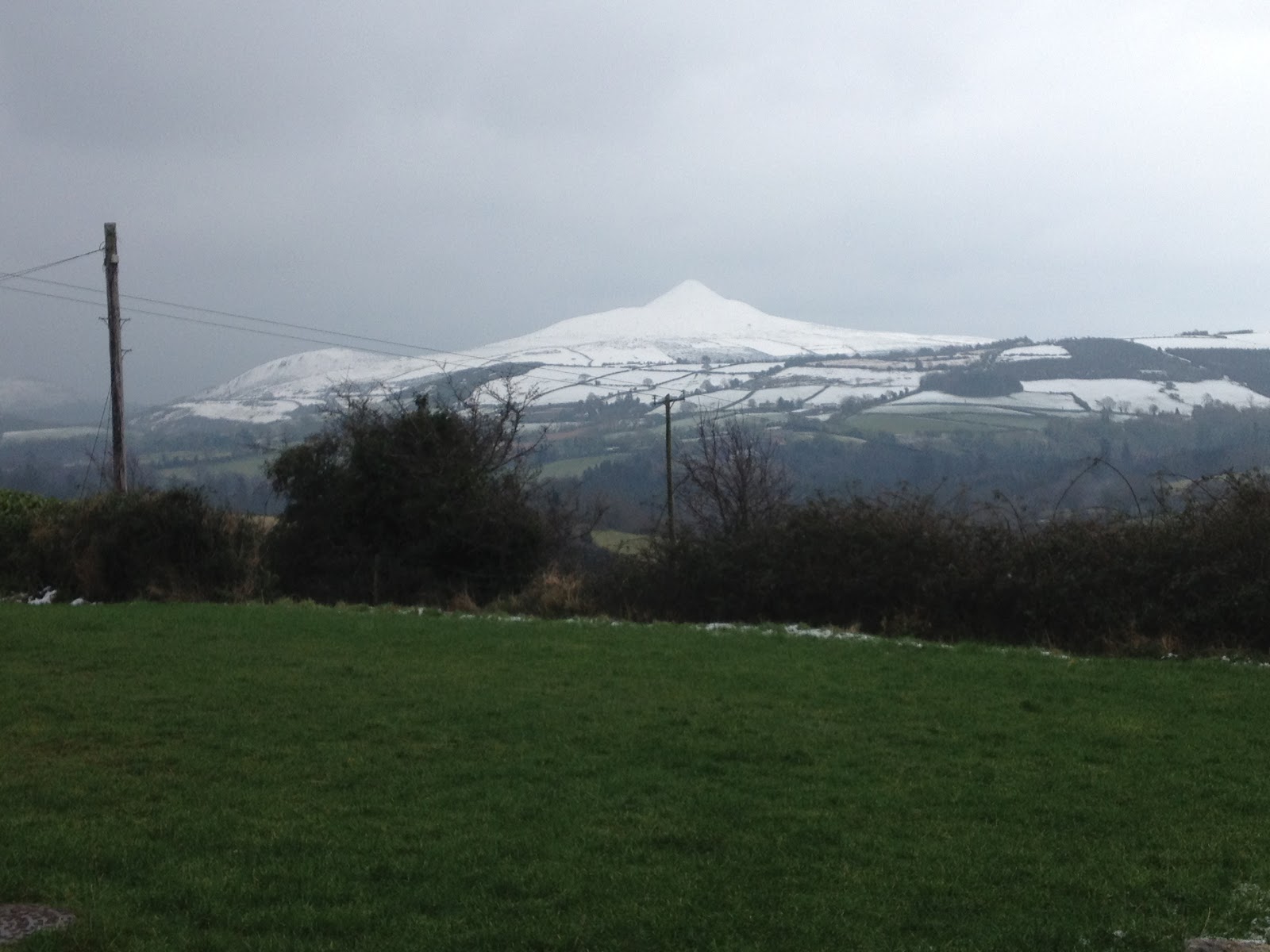
I have arrived in Ireland! Landing in Dublin around 9:00 local time, I met up with the 7 other SIT students and from there we set off into the mountains towards the Knockree Youth Hostel where we will be staying during our orientation. The van almost lulled me to sleep as it traversed the narrow and winding roads. The shift from city to country was sudden and before I knew it, I was staring at scenes fit for a postcard.

The hostel we are staying at is the first stop on the Wicklow Way Trail and according to one of the guides, has housed many Vermont hikers. It’s easy to see why Vermonters are attracted as Ireland’s resemblance to Vermont is uncanny and the fact that our arrival was on the day of the first snow sealed the deal for me.

Although we were exhausted from travelling, our group decided to go for a walk on a trail following the Glencree River led by our guide Jarek. Bundled up for all sorts of weather, we set off down the hill into the valley. The smell of the muddied path, wilted brown ferns, and mossy rocks reminded me of springtime in Vermont. But as we began to climb up the stone steps on one of the hills, the smell of spring gave way to the crunching of snow beneath our shoes. At the peak of our hike, we stood in a good 4 inches of snow, gazing across the valley to other snow-capped peaks.

View from our window


From the front door


Sugarloaf Mountain


We trekked home, slightly damp from sweat and the mist, which began to fall on our descent.  It was truly an incredible way to end our first day in Ireland.

*Since I’ve forgotten my camera cord at home, pictures from my camera phone will have to do for now. Hopefully I’ll be able to buy a new cord back in Dublin!